


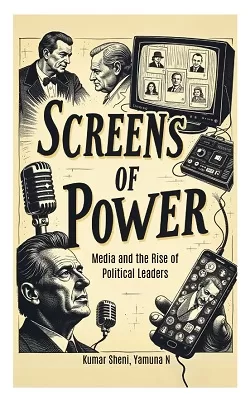
Description
Screens of Power: Media and the Rise of Political Leaders explores how media and technology have transformed political leadership, public engagement, and governance across history. From print to digital platforms, the book traces how each technological leap reshaped political power, charisma, and public perception, creating both democratic opportunities and challenges.
Beginning with the American Revolution, print media like Thomas Paine’s Common Sense mobilized citizens, proving media’s role as a revolutionary force. Radio introduced intimate communication, with Franklin D. Roosevelt’s fireside chats making leadership personal during crises. Television shifted focus to visual appeal, as seen in the 1960 Kennedy-Nixon debates, where Kennedy’s charisma trumped Nixon’s substance, highlighting image’s growing influence.
The rise of television and social media elevated narrative crafting. Leaders like Barack Obama and Narendra Modi used campaign ads and social platforms to build aspirational personas, with media actively constructing charisma, as per Max Weber’s insights. Social media democratized engagement, enabling movements like the Arab Spring, but also fueled misinformation and polarization, exemplified by the Cambridge Analytica scandal and algorithm-driven echo chambers.
Media framing shapes public perception, with leaders like Ronald Reagan benefiting from visionary portrayals, while others suffered from negative coverage. Populist leaders like Donald Trump and Modi bypassed traditional media, using platforms to foster loyalty and control narratives. Emerging technologies like AI and virtual reality promise further transformation but risk deepening digital divides and curated realities.
About The Author
Kumar Sheni serves as an Assistant Professor in Political Science at REVA University, Bangalore. He holds a Master of Arts from Mangalore University and is pursuing doctoral research on “A Study on Challenges of Weberian Bureaucracy in Post Colonial India” at Department of Political Science, Kuvempu University, Shivamogga. With a prolific writing career, Kumar has published over 50 articles on Indian politics in various Kannada newspapers and contributes extensively to academic and popular outlets. His research interests encompass Indian Government and Politics, Foundations of Political Theory, Comparative Politics, Public Administration, and Bureaucracy, reflecting his deep engagement with political dynamics and governance structures.
Yamuna N is an Assistant Professor at REVA University, Bangalore, with a Master’s in Mass Communication from NMKRV College, Bangalore University. With over eight years of cross-industry experience, she brings a practical, solution-oriented perspective to her academic interests, which include political communication, corporate communication, business journalism, and consumer behaviour. Her curiosity extends beyond the classroom to business case studies, marketing strategy, and innovation in market trends, reflecting her interdisciplinary and realistic approach to learning and teaching.




 Never Give up!
  HA-HA, HO-HO
  MOKSHAA
  Yoga Module
  Chasing the Shadows of Memory
  ADITYA - An ALS Warrior
  Inspiration
  The MASTER of Your KPIs (Paperback)
  My Tryst with Volunteerism
  Mona Lisa
  JOURNEY OF A YOGI’S SOUL - Part-02
  Methodology of waterproofing of Concrete structures by using Construction Chemicals
  Wings of Teenage - Your wings already exist; all you have to do is fly
  Chinrasu and Gemini
  The Autumn of Life
  ShahenShah - Story of ShrenikShah, the Cancer Conqueror
  Zara and the Enchanted Finger
  PODODHWONI
  Mann Ki Baat by Prime Minister Shri Narendra Modi
  Conceptual Physics For NEET / AIIMS / JIPMER
  Haunted Girl
  Mahamahim Rashtrapati Draupadi Murmu: Vyaktitva Evam Krititva
  Matlab - Based Programming For Essential Topics On Signal Processing
  Ever After: The Raja Rani Tales
  COMPUTER NETWORKS
  Gubbare
  Personal Finance Chalisa
  The Friendship Squad and the Mystery of the Missing Pupils
  Together But Still Apart: A True Saga of Love, Excitement and Pain (Paperback)
  Cardio Protect - A Guide for Natural Cardiovascular Health
  Keep Them Engaged!
  STORE MANAGEMENT AND OPERATIONS
  US555 - U!THE HEART OF BILLIONS ( Hardcover )
  The Catalona Bunch
  Habits Change into Character
  Business Strategies Post Pandemic
  Annmaikkalap Puthukkavithaigalin Pokkugal
  Essence Of Soul And Mind
  Journey Through My Dreams
  Quotation Anthology
  The Organization Development Book
  THE BLUE ECONOMY OF ANDHRA PRADESH: THE ROAD TO PROSPERITY
  PROGRESSIVE INDIAN - Empowering India with Progressive Mindset
Reviews
There are no reviews yet.