


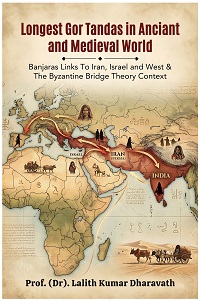
Description
The Byzantine Bridge Theory generally refers to the Byzantine Empire acting as a cultural and geographic bridge between the East (Persia/India) and the West (Europe) during the medieval period. Many historians investigate the theory that the Banjara (Gor) people are linked to the Roma (Gypsies) of Europe, suggesting a long-distance migration path from India through Iran (Persia) and the Byzantine territories into the West. Dr. Lalith Kumar Dharavath is a distinguished Professor (Retired) of Public Administration at Osmania University, Hyderabad. While he has authored over 125 books on the Banjara community, the specific title you mentioned appears to be a segment or subtitle from his extensive research on Banjara origins and migrations. Dr. Dharavath’s work meticulously reconstructs the history of the Gor Banjara, identifying them not merely as a regional tribe but as a global nomadic civilization. Central to his thesis is the “Byzantine Bridge Theory,” which posits that the Byzantine Empire served as a critical corridor for Banjara migrations from India to the West during the medieval period. He explores the “Longest Gor Tandas” (caravans), documenting their historical trade routes that linked the Indian subcontinent to Iran (Persia), Israel, and Europe. His research bridges the gap between vibrant oral traditions (Gor Boli) and archaeological evidence. He argues that the Banjara are the ancestral stock of the European Roma (Gypsy) populations, tracing shared linguistic and cultural markers across the Middle East. By examining the community’s role in ancient and medieval trade—acting as vital logistics providers for empires—Dharavath elevates the Tanda from a simple settlement to a sophisticated socio-economic unit that facilitated cross-continental cultural exchange. His work ultimately advocates for the preservation of this “endangered” heritage against the pressures of modern sedentary life.***
About The Author
Professor (Dr) Lalith Kumar Dharavath, born in 1959, is a distinguished Professor (Retd) of Public Administration at Osmania University, Hyderabad, Telangana, India, whose illustrious career encompasses teaching, pioneering research, academic administration, and advisory board stewardship. Prolific Author and writer, widely regarded among contemporary modern thinkers, he has, rendered substantial contribution to academia and governance through the successful completion of major research projects funded by UGC and ICSSR, New Delhi. He has mentored more than 25 PhD scholars and numerous M Phil. Candidate. while authoring over 125 books, published more than 4o research articles, editing several scholarly, books, magazines and academic journals. As a respected member of multiple research journal editorial boards, he has actively Participate in and presented papers at numerous national and international conferences, seminars workshops, and webinars. He also the propounded of the Resilience Theory Tanda Gor Banjar and Reciprocity theory and Practice. Reflecting his innovative intellectual engagement with socio -administrative discourse, and in recognition of his enduring scholarly excellence, he has been the recipient of many prestigious awards and honors.


 A False Alarm
  STORIES OF POSITIVITY TO BRIGHTEN UP YOUR DAY
  Saral Vaikalpik Chikitsa Paddhatiya
  THE INVISIBLE LAW OF KARMA
  UNICORN
  Cold Cock
  Haunted Girl
  Sports & Exercise Physiology and Nutrition
Reviews
There are no reviews yet.