

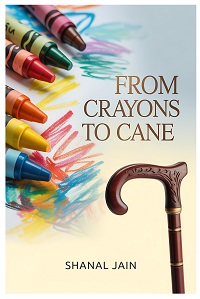
Description
Life is not a straight line — it’s a series of circles, overlapping moments, and quiet awakenings that turn us into who we are meant to be. From Crayons to Cane is a deeply human reflection on the passage of time — on the moments that shape us, the people who stay or drift away, and the quiet lessons that only living can teach.
Told through the voice of an unnamed narrator — an “I” that could be any of us — the book travels through eight chapters, each capturing a season of existence. From the wide-eyed wonder of childhood to the restless fire of youth, from the fragile beauty of love to the grace of growing old — every page holds a mirror to the reader’s own memories.
Each chapter is written like a conversation between the heart and time — honest, nostalgic, sometimes uncertain, but always hopeful. It does not rush to define life; it pauses to feel it. To listen to the sound of rain on a window, to remember the laughter of someone long gone, to find meaning in the quiet after chaos.
At its core, this book is not about one person’s story — it’s about every person’s story. It’s about the moments we all share in different ways: the first time we dream, the first time we fall, the first time we lose something we thought would stay forever — and how we keep going, carrying pieces of every version of ourselves along the way.
The pages unfold like stages of a single lifetime:
• Childhood, where imagination paints the world in endless colors.
• Teenage years, where questions outnumber answers, and every feeling is both a storm and a sunrise.
• Adulthood, where the chase for purpose begins — in the noise of cities, careers, and love.
• Parenthood, where love takes its most selfless form.
• Old age, where silence becomes a language, and acceptance turns into peace.
• And finally, the realization that every ending is only another beginning in disguise.
The beauty of From Crayons to Cane lies in its simplicity. There are no grand plot twists, no heroes or villains — only moments. The ones that slip quietly between the pages of our everyday lives but end up defining who we are.
Each chapter blends storytelling and reflection — small scenes painted with the colors of emotion, drawn from the ordinary days that often hold the most extraordinary truths. You’ll find rooftops and train rides, coffee cups and monsoon roads, lullabies and laughter, all stitched together by the invisible thread of time.
It’s a book meant to be felt more than read — to remind us that we’ve been many people in one lifetime, and all of them matter. That growing up is not about leaving behind our past selves, but learning to hold them gently.
Because somewhere between the first page and the last, we realize that every chapter — no matter how uncertain or imperfect — was essential to the story we were always meant to tell.
And in the quiet reflection of its final line, one truth remains:
This is not my story or yours.
This is the story of us — the book we’ve all been writing without knowing.
About The Author
Shanal Jain is a storyteller, a thinker, and a believer in the quiet power of human connection. His words often emerge from life’s simplest moments — a late-night reflection, a conversation with a friend, or the sight of a sunset over a busy street. For him, writing isn’t about telling stories; it’s about understanding the emotions that shape them.
Professionally, Shanal works as a Project Manager at a Cyber Security firm, where precision, strategy, and problem-solving define his days. But beyond the world of deadlines and delivery, he is also a Mathematics Tutor, finding joy in simplifying complexities and helping others see the beauty in logic.
Yet, between these structured roles, there lives the observer — the part of him that listens to life, watches people grow, and writes about the journeys we all share. His creative venture, From Crayons to Cane was born out of years of reflection — moments spent wondering how time transforms us, how innocence turns into wisdom, and how every stage of life leaves a different mark on the same soul.
Through this book, Shanal invites readers to pause — to look back without regret, and forward without fear. His storytelling style is deeply human, blending realism with tenderness, capturing the feelings that connect us all: love, loss, hope, and rediscovery.
He believes that life is not a straight road, but a series of evolving chapters — each written by a version of ourselves we are still learning to understand. His work doesn’t offer answers, only mirrors — reflecting the reader’s own experiences, memories, and quiet questions.
When he isn’t managing projects or teaching, Shanal finds peace in creative expression — designing, journaling, and mentoring young dreamers who remind him of life’s endless potential. Mumbai, his home and muse, often finds its way into his words — with its noise, its rhythm, and its ability to hold a thousand stories in a single day.
In Shanal’s words:
“I wrote this book to remind us that we are not defined by one version of ourselves. We are all still becoming — still learning, still feeling, still writing our story. This isn’t just my book. It’s the book of us — the one we’ve all been writing without knowing.”

 Code of Civil Procedure, 1908 - Tool kit
Reviews
There are no reviews yet.